
Seeing Through the World
Jean Gebser and Integral Consciousness
with Jeremy D Johnson
5 live, online classes hosted on Zoom
Starts Wednesday, January 28 @ 5 PM PT / 8:00 PM ET
All sessions recorded and made available for later viewing
Jeremy D Johnson, host of Mutations Podcast and author of Seeing Through the World, offers a five-week exploration of Jean Gebser’s “structures of consciousness." Interpreting Gebser’s magisterial text, The Ever-Present Origin (1949) as both a prophetic work and a spiritual treatise for an age of climate crisis and intelligent machines, this course sifts through the troubled present. It is in our present, as Gebser intimated, that we find the seed crystal of a new worldview.

Jean Gebser (1905-1973) was a philosopher, poet, and phenomenologist of integral consciousness best known for his magisterial The Ever-Present Origin (Ursprung und Gegenwart, 1949). Writing in the mid-century during a period of intense cultural transformation and crisis in Europe, Gebser intuited a series of mutational leaps spanning the history of human consciousness, the latest of which he called the “integral” structure.
The integral mutation, Gebser observed, had begun to emerge in the early twentieth century. From the curved space of Albert Einstein’s relativity, to the chaos mathematics of Henri Poincaré, to the impossible gestures of cubism: each of these, Gebser observed, indicated a dramatic leap from the classical linear conceptions of “space” to a strange new “time.”
This new consciousness of time was not the clock-time of modernity but a time of a “most complex” nature. It described a world that was entangled, relational, and yet characteristically open. It was a world “without opposite,” Gebser emphasized, one that had overcome the subject-object duality of the Enlightenment.
The new mutation did not center modern thought, nor a progression forward to a more advanced consciousness. What it seemed to call for was integration. Earlier structures of consciousness were to be recognized as co-present and even co-valid with modern consciousness. Human beings were not exclusively ‘modern,’ nor were they ‘archaic.’ They were the integrity, the wholeness of their mutations. It was the whole which was shining through, pressing towards new awareness in the ‘transparent’ present.
George Braque, Man with Guitar 1911.
From the discovery of the unconscious to artistic movements like Dada and Surrealism, the past had begun to break into the present. So too had the future. Cubists were aspiring to depict time itself in their paintings, their figures appearing to move simultaneously backwards and forwards, left and right, in ways that mirrored the strange behaviors of quantum physics.
Meanwhile, French philosopher Henri Bergson had declared “time is not space,” replacing clock-time with durée (duration).
Time seemed to be coming to consciousness everywhere.
“I sense space abolishing itself,” wrote the poet Paul Eluard, “and time increasing in all directions.”
With the dangerous rise of fascism in Europe and the runaway technological forces of ‘progress’ hurling civilization into crisis, Gebser understood that the ‘spatial’ consciousness of modernity had exhausted itself. The modern world had initiated a period of dramatic upheaval and revolutionary change. It had harnessed the forces of time and nature in the name of progress, but it was not capable of mastering these same forces. The machines of progress continued to ‘emancipate’ themselves from human hands, becoming runaway forces. Only an integral consciousness of the world, one which had overcome the “bifurcation” between human beings and nature, and overturned classical linear notions of space and time, could match the intensity of these new realities.
The imperative, then, was to bring this new consciousness to the forefront of awareness, to indicate where the seed crystals of a new reality were already present.
There, as the Romantic poet Hufeland described, we would find a “new strength of spirit.”
Gebser’s magnum opus, The Ever-Present Origin (Ursprung und Gegenwart) provides a sweeping history of consciousness. It is both rich with detail and expansive in vision.
The host of this course, Jeremy Johnson, invites participants to see this text as wayfinding companion in a time of intelligent machines and ecological catastrophe. It offers a re-enlivenment of the past “structures” of consciousness, but also a deep attunement to the presence of the future. Alongside the past, the future also shapes the present. The radical breakthroughs of art and physics in the last century are, in a sense, events which are still happening.
We are entangled, like one of the strange superpositions of the quantum world, in a cultural transformation still in the making.
More than ever, then, we must come to see how the future coalsces in the present, and “ripens” in us, as the poet Rainier Maria Rilke ha described. The new mutation perceives a time and space in open relation.
Our class distills Gebser’s insights into a series of five lectures, and additional in-depth office hours sessions.
These lectures are catered for both newcomers to Gebser’s philosophy as well as seasoned alumni. In either case, participants are invited to see this class as a deepening into shared inquiries, and a practice of “living the questions” in a time of unthinkable worldview shift.
**
“Transparency has always been waiting within us. To try to ‘grasp’ it by means of the forces of consciousness… is a futile endeavour. Our task, as it were, is to weed [jäten] the innermost ground of our being every day in order to prepare the ‘breakthrough to the essence of being’ [Durchbruch zum Wesen] without straining into the distance after the ‘great experience’… Whoever participates in it is also indebted to humanity: for every grain of transparency that is realised by a single individual intensifies the spiritual power of humanity [as a whole]. To give an earthly home to this all-pervading force, a conscious homeland, is of decisive importance in today’s cosmic moment.” (Jean Gebser, ‘Homologies in Spiritual Attitude’)
Gebser’s insights into the phenomenology of human consciousness has offered profound intellectual depth—and spiritual transmission—to the field of integral philosophy and consciousness studies, influencing the works of American historians such as William Irwin Thompson and the philosopher Ken Wilber. Further syncretic corroboration links Gebser’s integral epoch to those of the Indian revolutionary and yogi Sri Aurobindo’s “integral yoga” (The Life Divine) and Pierre Teilhard de Chardin’s evolutionary mysticism (The Human Phenomenon).
As William Irwin Thompson writes, “Gebser was a brilliantly intuitive mystic with a profound understanding of poetry and art,” and that Ever-Present Origin is, “the kind of book that changed one’s life.” Georg Feuerstein, Gebser's colleague and friend, wrote that, “Socratic spirits like Gebser typically live before their time… perhaps the present climate is more receptive to Gebser’s arguments.”
The future lives in us. In this era of meta-crisis, Gebser’s time has come yet again to help us navigate a liminal epoch between worldviews and realities.
Course Format
The course consists of five lectures, presented live each week via Zoom, as well as an optional weekend office hours session.
Lessons occur on Wednesdays at 5 pm PT / 8 pm ET and office hours are hosted on Sundays, at 9:30 am PT / 12:30 pm ET.
All lectures and discussions will be recorded and made available on the course platform. Students who cannot attend the live classes can enjoy them asynchronously on the course portal.
Jean Gebser’s The Ever-Present Origin and Jeremy Johnson’s Seeing Through the World will be in our weekly recommended reading list.
Reading is not a pre-requisite, nor a requirement, for attendance. Additional excerpts and a syllabus will also be provided in the course forum.
Class Outline
The course will begin on Wednesday, January 28 and runs for five consecutive weeks.
Lectures will be held on Wednesdays at 5:00 pm PT / 8 pm ET.
Office Hours will be held on Sundays at 9:30 am PT / 12:30 pm ET.
All sessions are held for approximately 90 minutes.
Lessons
Lesson I - Introduction - Time Increases in all Directions
Lesson II - Our History is Mutational: The Structures of Consciousness Model
Lesson III - Myth, Magic, and Machines: Past Becomes Present
Lesson IV - Breaking Forth of Time: Upturning the Progress Narrative
Lesson V - In the Danger, the Saving: Integral Consciousness and the Presence of the Future
Bonus Guest Speaker Sessions [New!]
Cynthia Bourgeault: A Mystic’s Take on Gebser, Integral Consciousness and the Spiritual Import of it All [Recorded on Sunday, Feb. 22]
More guest speakers to be announced!
Student Learning Outcomes
Students will:
participate in a reading of Ever-Present Origin, in an attempt to make new connections with our modern world
explore a host of other, related works (poetry, film, fiction, philosophy, etc.) to deepen their understanding of key themes and ideas
cultivate embodied and experiential insight on the structures of consciousness — the archaic, magic, mythic, mental and integral — in their daily lives
familiarize themselves with Gebser’s core insights into integral consciousness, such as ‘time concretion,’ ‘systasis’ and ‘diaphaneity’(transparency)
acquire tools for participatory knowing that help them to navigate a culture of extreme fragmentation and worldview transition
have opportunities to converse with the instructor and their peers in an environment of open inquiry and mutual learning
join a community of seekers who believe in the transformational potential of consciousness and culture, and the power of art, imagination, and contemplative wonder to help realize a more beautiful world
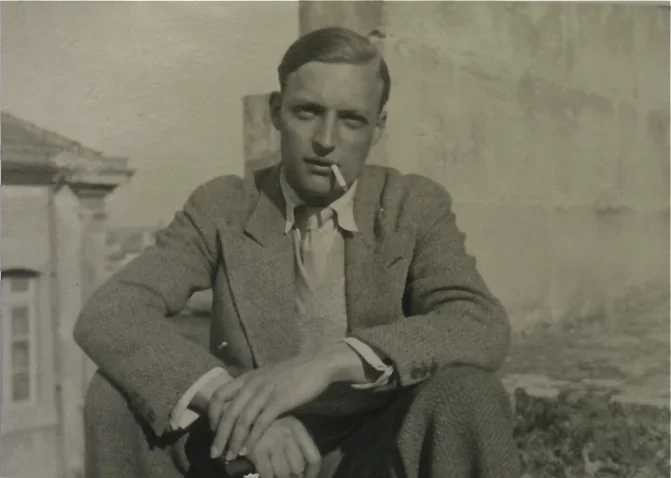
Photograph of a young Gebser.
Registration: $175
Mutations alumni (those who have taken any previous course with us) receive a $25 discount. Register here.
Student rates:
Send us a note to receive a pay-what-you-can registration link: jeremy (at) mutations (dot) blog
Thank you, and see you in class!
Returning Students:
Register here if you’re already a ‘mutant’ on the Mutations network.